AI-DAPT Reference Architecture
Overview
The AI-DAPT Reference Architecture is structured around a comprehensive set of services, conceptually divided into eight (8) layers to ensure efficient data and AI lifecycle management.
The architecture’s communication framework enables seamless interactions between services by leveraging real-time distributed message brokers for instant and reliable communication, and REST API endpoints for structured data exchange. By integrating these technologies, AI-DAPT ensures efficient, scalable, and interoperable AI and data management, effectively addressing the evolving needs of stakeholders.
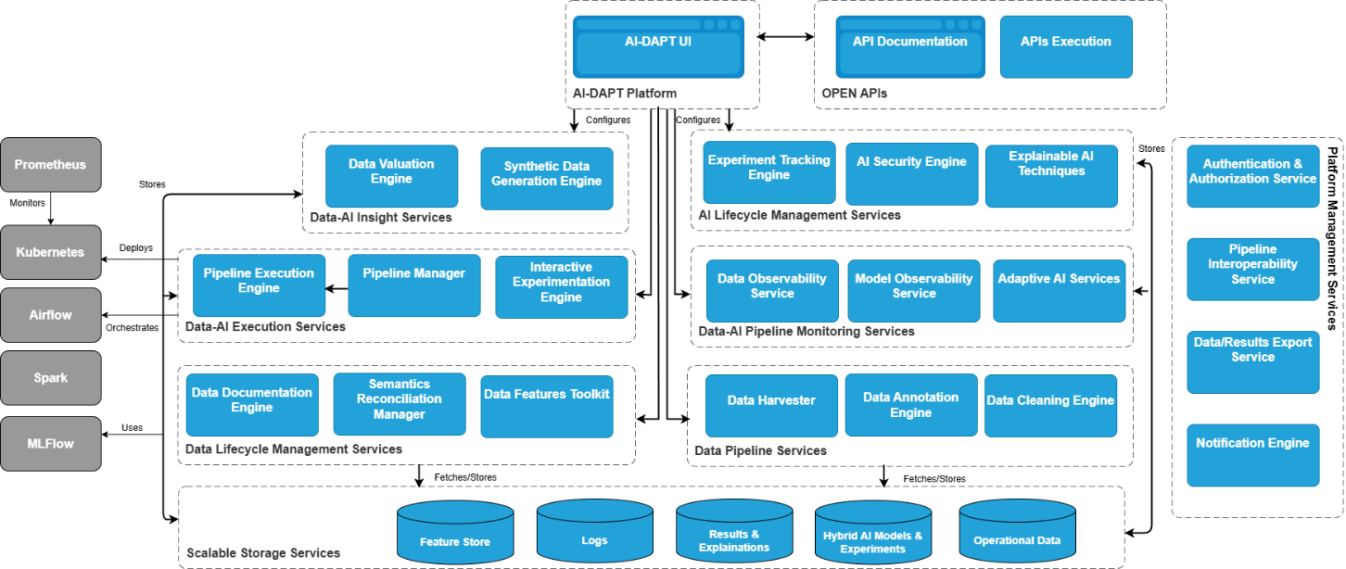
Architecture Layers
Scalable Storage Services
Support various data persistence needs, storing datasets, AI models, pipeline configurations, operational logs, and metadata for optimized discoverability and query performance.
Data Pipeline Services
Responsible for fetching, annotating, and cleaning data across batch and streaming modes.
- Data Harvester
-
Fetches the required data at rest (batch files) or data in motion (near real-time data).
- Data Annotation Engine
-
Performs semantic annotations at feature structure level, mapping them to an appropriate data model supported in the Semantics Reconciliation Manager, and applies any harmonization/transformation needed on feature values.
- Data Cleaning Engine
-
Applies appropriate user-defined and/or automated ML-based cleaning rules.
Data Lifecycle Management Services
Facilitate consistent data collection and management by configuring appropriate data pipelines.
- Data Documentation Engine
-
Responsible for storing and managing metadata at dataset and feature levels, acting also as the data asset catalogue of the platform.
- Semantics Reconciliation Manager
-
Serves the platform with cross-domain data models, ensuring integrity, validity, and adaptability to evolving stakeholder needs.
- Data Features Toolkit
-
Helps users with feature engineering during data preparation for AI and analytics, tailoring features for model training to improve model performance.
Data-AI Execution Services
Orchestrate the execution of data and AI pipelines by managing service invocations and ensuring secure, reliable data handling.
- Pipeline Execution Engine
-
Executes pipelines while guaranteeing performance requirements. Continuously monitors pipeline performance and execution status, stores results and metrics in the AI-DAPT Scalable Storage Services, and allocates required resources using the DAG generated by the Pipeline Manager.
- Interactive Experimentation Engine
-
Provides an environment for interactive development and early experimentation using computational notebooks.
- Pipeline Manager
-
Assists in the design, configuration, and management of both data-driven and AI-focused pipelines. Offers a collection of prebuilt data transformation functions, integrates with other AI-DAPT services to improve data processing, and features a catalogue of AI/ML algorithms for model training and deployment.
Data-AI Insights Services
Enable collaboration between business experts and data scientists, offering tools to extract valuable insights.
- Data Valuation Engine
-
Assesses data quality and bias.
- Synthetic Data Generation Engine
-
Allows controlled generation and evaluation of synthetic data using generative AI models.
Data-AI Pipeline Monitoring Services
Ensure real-time oversight of deployed pipelines.
- Data Observability Service
-
Monitors data pipeline execution, detects anomalies, and raises alerts.
- Model Observability Service
-
Tracks AI model performance over time, identifies drift, and recommends retraining or adaptive AI techniques.
- Adaptive AI Services
-
Helps users ensure the robustness and performance of production models through human-in-the-loop strategies. Integrates model and data observability metrics with user-defined rules to generate relevant alerts and recommendations that may trigger model retraining or rebuilding, pending human review and approval.
AI Lifecycle Management Services
Handle the design, validation, and execution of AI models and their associated pipelines.
- Experiment Tracking Engine
-
Enables users to track, compare, and optimize model training experiments.
- AI Security Engine
-
Identifies and mitigates potential adversarial attacks on AI models.
- Explainable AI Techniques
-
Provides a range of methods aimed at improving the understanding of trained hybrid AI models, allowing users to gain a clearer view of how the models operate internally.
Platform Management Services
Provide essential security, access control, interoperability, and notification mechanisms across all layers.
- Authentication & Authorization Service
-
Ensures secure access control.
- Notification Engine
-
Manages user-defined alerts and event notifications.
- Data/Results Export Service
-
Facilitates secure extraction and accessibility of requested data.
- Pipeline Interoperability Service
-
Enables seamless integration with external AI-DAPT-compliant solutions.
Open-Source Technology Stack
AI-DAPT leverages a powerful suite of open-source tools organized into several key areas.
Data Storage and Management
| Tool | Description |
|---|---|
MinIO |
High-performance, distributed object storage for efficient data storage and retrieval. |
MongoDB |
Flexible NoSQL database solutions for managing large volumes of unstructured data. |
Virtuoso |
Semantic data integration with RDF and SPARQL support for linked data management. |
PostgreSQL |
Open Source Relational Database |
Keycloak |
Open Source Identity and Access Management solution. |
Data Processing and Analytics
| Tool | Description |
|---|---|
Apache Spark |
Large-scale data processing, enabling high-speed analytics and machine learning on distributed datasets. |
Apache Kafka |
Reliable message broker for real-time data streaming and communication between components. |
Workflow and Lifecycle Management
| Tool | Description |
|---|---|
Apache Airflow |
Orchestrates complex workflows, automating and scheduling tasks within the AI pipeline. |
MLflow |
Manages the end-to-end machine learning lifecycle, including experiment tracking, model versioning, and deployment. |
Together, these tools provide a robust, scalable foundation that streamlines AI development, deployment, and performance optimization across the AI-DAPT platform.