Developer Guide Overview
This section provides technical documentation for developers working on or integrating the Data Valuation Engine.
The Data Valuation Engine is a service-oriented system that supports:
-
Feature Correlation
-
Feature Importance
-
Spatial Bias Audit
-
Spatial Bias Mitigation
It is designed to run both as a standalone tool and as part of data pipeline.
Architecture
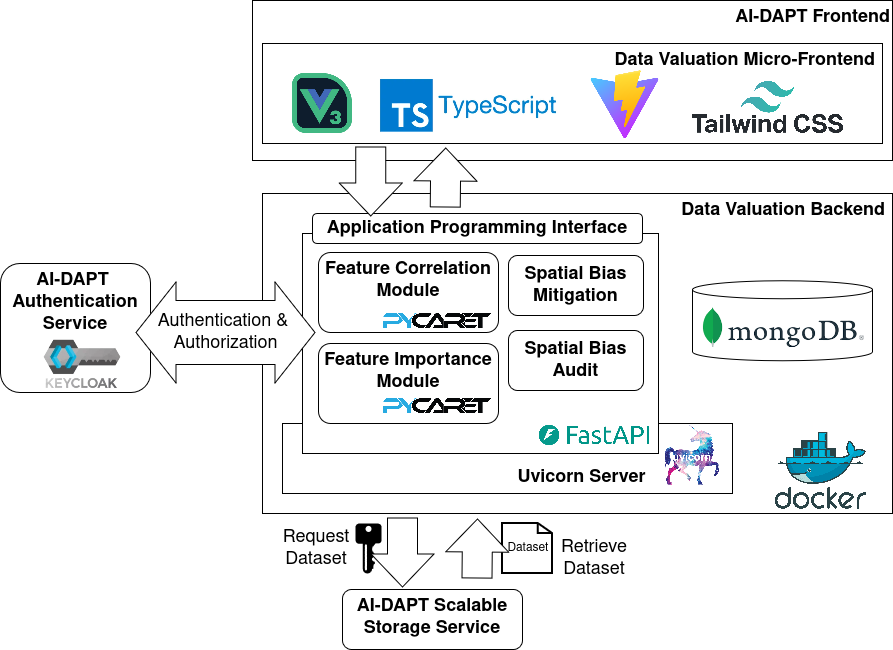
This section provides technical documentation for developers working on or integrating the Data Valuation Engine within the AI-DAPT platform. Specifically, it is delivered as a micro-frontend plus a backend service, and it can run standalone or integrated into AI-DAPT. The system is composed of the following main components:
-
Backend API – Python 3.10, FastAPI, Uvicorn
-
(Micro-) Frontend UI – Vue 3, TypeScript, Vite, Tailwind CSS
-
Machine Learning Modules – PyCaret for model training, SHAP for explainability
-
Communication with data pipelines and data storage – MongoDB
-
Authentication – Keycloak
The following image highlights the previously-mentioned modules of the system and how they interact with AI-DAPT services.
The backend exposes REST endpoints that the micro-frontend or other components can call for:
-
correlation analysis
-
feature importance analysis
-
spatial bias audit
-
spatial bias mitigation (relabeling and threshold adjustment)
-
task-based (HITL) workflows
The frontend consumes these APIs and visualizes results using tables, plots, and interactive maps.
Core Concepts (Developer Perspective)
-
Standalone vs data pipeline workflows Some endpoints operate on fully provided request payloads (standalone). Others operate on persisted configuration documents (Dave tasks), enabling Human-in-the-Loop workflows.
Repository Structure
.
├── backend/        # FastAPI backend
├── frontend/       # Vue 3 frontend
├── docker-compose.yml
├── .env-example
└── docs/           # Antora documentation (this section)
Getting Started (Local)
Quick start
# Create Docker network (first time only)
docker network create experiment-network

# Build and run
docker compose up --build
The application will be available at:
-
Frontend UI:
http://localhost:3000 -
Backend API:
http://localhost:8082 -
OpenAPI docs:
http://localhost:8082/api/docs
Development Notes
-
MongoDB and Keycloak are controlled via environment variables.
-
Task-based (HITL) endpoints rely on persisted configuration documents and are typically used in interactive workflows.